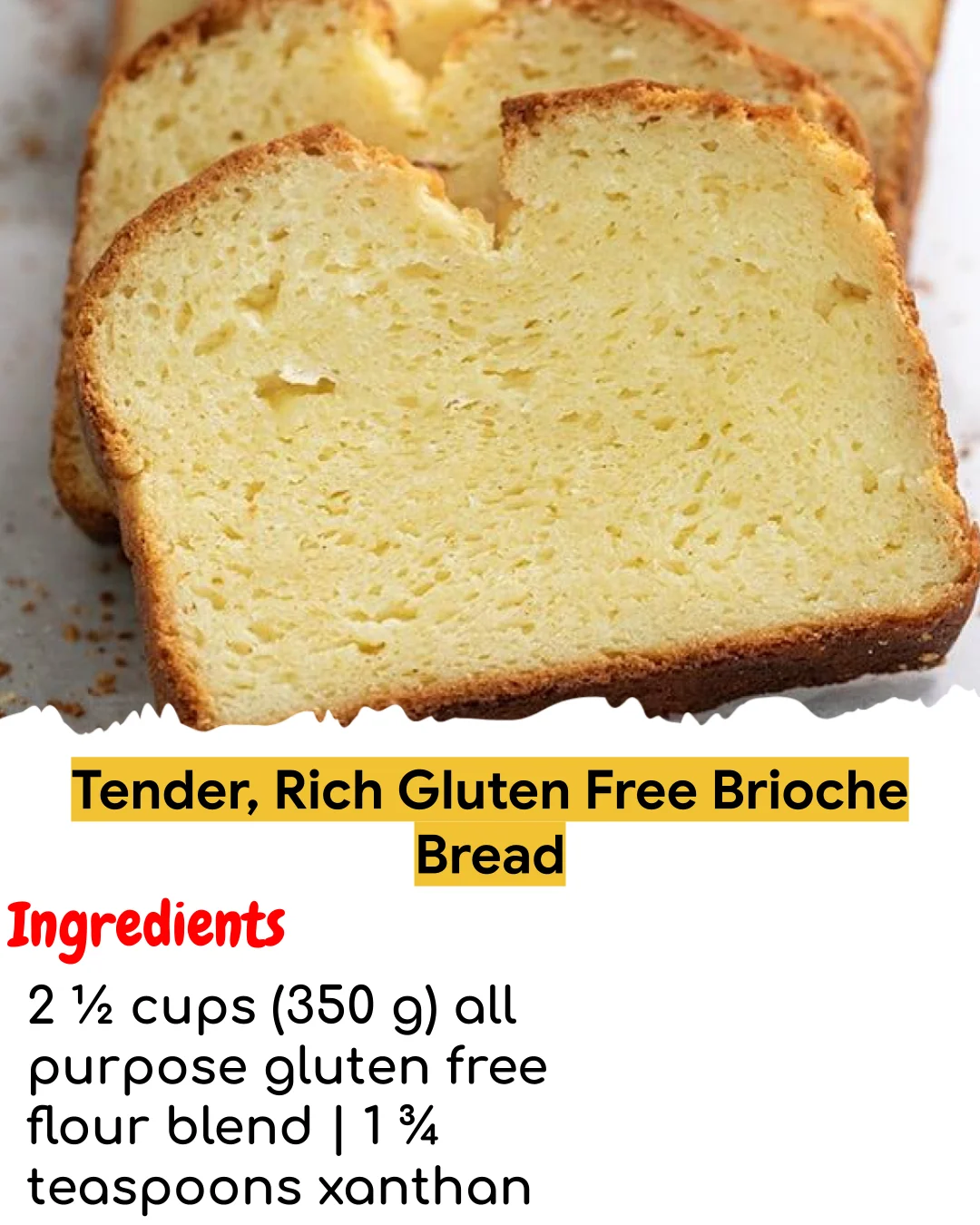
Tender, Rich Gluten Free Brioche Bread (Chef-Developed)




























Cooking and Serving: 21 minutes | 1 standard loaf bread
Ingredients
2 ½ cups (350 g) all purpose gluten free flour blend | 1 ¾ teaspoons xanthan gum, omit if your blend already contains it | ½ cup (100 g) granulated sugar
Description
Prep Time: 20 minutes | Cook Time: 1 hour hr | Total Time: 21 minutes | Servings: 1 standard loaf bread
Ingredients
2 ½ cups (350 g) all purpose gluten free flour blend
1 ¾ teaspoons xanthan gum, omit if your blend already contains it
½ cup (100 g) granulated sugar
1 ½ teaspoons (5 g) instant yeast (See Recipe Notes)
1 teaspoon cream of tartar
¾ teaspoon (5 g) kosher salt
½ teaspoon apple cider vinegar
5 (250 g (weighed out of shell)) eggs, at room temperature
½ cup (4 fluid ounces) warm milk, about 95°F
10 tablespoons (140 g) unsalted butter, at room temperature, roughly
Instructions
Grease and line a standard 9-inch x 5-inch loaf pan and set it aside.
In the bowl of a stand mixer fitted with the paddle attachment (See Recipe.
Notes
* What to expect during the rise of this gf brioche bread
* Ingredient substitutions
* Gluten Free Brioche Bread Recipe
I consider brioche bread a luxury. One single loaf calls for 5 whole eggs, and 5
ounces of butter, at room temperature.
To me, all those eggs and butter in a fragrant loaf of bread, with a thick but
tender crust and a rich flavorful crumb, sounds dreamy. It certainly has its
place. And its place is often soaking in more of the same to make French toast!
This bread is not low fat, or low-calorie. It’s an indulgence, and I enjoy it
more than if I thought of it like an everyday loaf.
I don’t count calories, and I don’t think of any foods as “bad.” Everything in
Sliced brioche bread on white paper on a bread board
brioche bread on white paper on a bread board
WHAT TO EXPECT DURING THE RISE OF THIS GF BRIOCHE BREAD
The many eggs in this loaf of bread help it rise, but it does still call for
yeast. You’ll find that it doesn’t call for a ton of yeast, though.
Since brioche has a somewhat tighter crumb than a classic sandwich bread, it’s
meant to rise very high. It should rise to about 150% of its original volume,
but not more. If you are tempted to add more yeast, know that the loaf won’t
rise higher, but will just have a more jagged top.
Raw risen and scored brioche bread dough in loaf pan
risen and scored brioche bread dough in loaf pan
GETTING YOUR YEAST BREAD TO RISE
The key to getting your brioche bread to rise is patience. Highly enriched bread
with lots of butter and eggs usually rise quite quickly, sometimes in only 40
minutes during the hot, humid days of summer. In winter, it can take nearly 2
Do not put it in a low oven, or you may kill the yeast before it gets a chance
to rise. I do often turn on my oven to about 300°F and place the loaf pan on top
of the stove. That bit of gentle ambient heat helps it rise more steadily.
If your yeast bread is still rising, it has begun to overproof when the surface
of the dough has begun to rise unevenly, taking on a broken or pockmarked
appearance. Just moisten your fingers to smooth out the rough edges, and then
ROOM TEMPERATURE INGREDIENTS
If your butter is at proper room temperature for mixing (about 68°F), but your
eggs are cold, the butter will clump and won’t combine fully. You’ll have
pockets of melting butter leaking out of the bread during baking.
Brioche bread baked in loaf pan with white paper
bread baked in loaf pan with white paper
INGREDIENT SUBSTITUTIONS
If you can’t have dairy, I would normally steer you toward a bread recipe that
Try replacing the butter with vegan butter. My favorite brands remain Melt and
Miyoko’s Kitchen. I love them equally.
In place of the milk, try any nondairy milk you like. Just make sure it’s
unsweetened and unflavored.
You can’t replace 5 eggs in a single recipe with any sort of egg replacer.
Brioche bread is just not egg-free-friendly. You’d need a vegan-style recipe
that was developed egg-free.
This is a recipe for yeast bread, and cannot be made without commercial yeast.
It also cannot be made with gluten free sourdough starter
which requires a gluten free sourdough bread
developed specifically for it.
I always bake yeast bread with instant yeast, since it doesn’t have to be
dissolved in liquid, and you need less of it. Instant yeast is also called
rapid-rise and breadmaker yeast. It’s all the same.
If you don’t have instant yeast and would like to use active dry yeast instead,
Brioche bread 3 slices each on a separate small plate with butter in background
bread 3 slices each on a separate small plate with butter in background
Go Ad-Free
GLUTEN FREE BRIOCHE BREAD
Prep Time: 20 minutes mins
Rising time: 1 hour hr
Total Time: 2 hours hrs 20 minutes mins
Yield: 1 standard loaf bread
This highly enriched loaf of gluten free brioche bread is a lightly sweet,
buttery, bakery-style loaf with a tender yellow crumb and a deep brown, but not
especially crispy, crust. Perfect for French toast!
* Stand mixer fitted with paddle attachment
* 2 ½ cups (350 g) all purpose gluten free flour blend
(I used Better Batter; you must use one of my recommended blends so please
click thru for full info)
* 1 ¾ teaspoons xanthan gum, omit if your blend already contains it
* ½ cup (100 g) granulated sugar
* 1 teaspoon cream of tartar
* ¾ teaspoon (5 g) kosher salt
* ½ teaspoon apple cider vinegar
* 5 (250 g (weighed out of shell)) eggs, at room temperature
* ½ cup (4 fluid ounces) warm milk, about 95°F
* 10 tablespoons (140 g) unsalted butter, at room temperature, roughly
* Grease and line a standard 9-inch x 5-inch loaf pan and set it aside.
* In the bowl of a stand mixer fitted with the paddle attachment (See Recipe
whisk to combine well.
* Add the salt, and whisk again to combine. Add the vinegar, eggs, milk, and
* Place the bowl in the stand mixer and beat on medium-low speed for about 30
seconds. Increase the speed to medium-high, and beat for at least 2 minutes.
Scrape down the sides of the bowl, and beat on high speed for another 2
* Transfer the dough to the prepared loaf pan, pressing the dough firmly into
the corners. Using a moistened spatula, smooth the top.
* Cover the pan with lightly greased plastic wrap, and place the pan in a warm,
draft-free location until the dough has reached the top edge of the loaf pan.
This can take an hour, or it can take much longer, depending upon the rising
environment. In cool, dry weather, it may take significantly longer.
* Overproofing is not a function of time, but of rise. When the surface of the
dough begins to take on an uneven, pockmarked appearance, it has begun to
* When the dough has reached the end of its rise, preheat the oven to 375°F.
Remove the plastic wrap, score the loaf down the horizontal center using a
lame or sharp knife at a 45° angle, cutting about 1/4 inch deep.
* Place the loaf in the center of the preheated oven, and bake for 25 minutes.
Rotate the pan 180° in the oven and bake for another 20 minutes.
* For a less browned crust, remove the loaf pan from the oven and transfer the
bread to a large piece of aluminum foil. Wrap the bread completely in the
foil and continue to bake for another 5 to 10 minutes, or until the inside of
the loaf has reached at least 190°F.
* Remove from the oven, unwrap the loaf, and allow the loaf to cool on a wire
rack. For a softer crust, keep the loaf wrapped for at least 20 minutes when
it first comes out of the oven, and then unwrap to cool until no longer hot
to the touch. Slice and serve.
* For a deeper golden brown crust, remove the loaf pan from the oven, transfer
the bread to a baking sheet and then return it to the oven. Continue to bake
for another 5 to 10 minutes, or until the inside of the loaf has reached at
least 190°F. Remove from the oven and transfer the loaf to a wire rack to
cool until no longer hot to the touch. Slice and serve.
Instant yeast is also called rapid-rise or breadmakers yeast. It can be replaced
with active dry yeast, but you’ll need to 25% more active dry yeast than the
instant yeast called for in the recipe, and handle it differently.
Here, instead of 5 grams instant yeast, you can use slightly more than 6 grams
of active dry yeast (5 x 1.25 = 6.25). You’ll need to dissolve it in the milk
first, though, and allow it to bubble up before adding it with the wet
About using a stand mixer
I’ve never successfully made this bread without using a stand mixer, fitted with
the paddle attachment. If you don’t have a stand mixer, you can try using a food
If I were to attempt to make this bread in a food processor, I’d begin by
processing the butter, sugar, eggs, and vinegar first until very well-combined.
Then add the remaining ingredients and process fully.
Nutrition information is automatically calculated, so should only be used as an
Brioche bread whole loaf and brioche bread slices
bread whole loaf and brioche bread slices