Cooking and Serving: 65 minutes | 6 servings
Ingredients
Why this recipe works | How to make gluten free focaccia | Ingredient substitutions
Description
Prep Time: 25 minutes | Cook Time: 40 minutes | Total Time: 65 minutes | Servings: 6 servings
Ingredients
Why this recipe works
How to make gluten free focaccia
Expert tips
Ingredient substitutions
Instructions
WHY THIS RECIPE WORKS
This recipe solves the problem of dense, gummy gluten-free bread. Its precise,.
repeatable method delivers consistent, bakery-quality results with the light,.
open crumb that gluten-free bread often lacks.
The most critical factor is the gluten free flour, specifically King Arthur.
Flour’s Gluten-Free Pizza Flour blend. My exhaustive testing shows it provides.
the best structure for large interior holes, crisp exterior, and a high rise.
other blends can’t quite match.
Success also comes from technique. A full four-minute mix of the dough creates a.
smooth, integrated dough, and two-stage baking maximizes “oven spring” and still.
delivers a fully baked interior.
This simple, exacting recipe eliminates guesswork and delivers.
professional-quality focaccia.
Closeup of a piece of bread dipped in oil inside a small wooden bowl, with more.
sliced focaccia visible in the background. The crust is deeply golden and crisp.
of a piece of bread dipped in oil inside a small wooden bowl, with more sliced.
focaccia visible in the background. The crust is deeply golden and crisp.
INGREDIENTS EXPLAINED
There are only a few ingredients in this whole recipe. Here is a bit about the.
important role each one plays:.
Labeled ingredients displayed on a white surface, including bag of gluten free.
flour, olive oil, honey, yeast, water, vinegar, and salt.
ingredients displayed on a white surface, including bag of gluten free flour,.
olive oil, honey, yeast, water, vinegar, and salt.
Gluten free pizza flour – King Arthur Flour’s Gluten Free Pizza Flour blend.
works best to give this bread the highest rise and best authentic crisp.
texture outside and airy crumb inside. You can also use Caputo Fioreglut.
gluten free flour or my own gluten free bread flour blend, with varying.
Instant yeast – Gives this bread its rise and adds flavor. I prefer instant.
yeast because you don’t need to soak it first to dissolve the outer layer.
before adding to the rest of the recipe.
Warm water – Hydrates the dough, activates the yeast, and brings the dough.
Honey – To feed the yeast and add a touch of depth of flavor and sweetness.
Olive oil – Flavors the bread, adds fat for moisture and tenderness.
Apple cider vinegar – Adds subtle flavor and helps to activate the yeast for.
a better, pillowy rise.
Salt – Adds flavor, and controls the activity of the yeast.
Angled view of a golden brown bread loaf with thick slices cut and resting in.
front, placed on a sheet of parchment with a serrated knife and a dish of oil.
view of a golden brown bread loaf with thick slices cut and resting in front,.
placed on a sheet of parchment with a serrated knife and a dish of oil partially.
HOW TO MAKE GLUTEN FREE FOCACCIA
In the bowl of a stand mixer whisk together the flour blend and the instant.
yeast. Then, whisk in the salt separately to ensure that the salt and yeast.
don’t clump together, or the salt will inhibit the yeast development too much.
Add all the wet ingredients, the warm water, then 3 tablespoons of olive oil,.
vinegar and honey. Pour the water into the center of the bowl first, and then.
the other liquids on top so the other liquids begin to combine with the water,.
rather than clumping in the dry ingredients.
Beat with the paddle attachment first on low speed until a dough begins to form.
so the dry ingredients don’t scatter. Then, turn up the mixer speed to.
medium-high and beat for 4 full minutes. This will ensure a fully integrated,.
smooth dough that is as easy to handle as possible (although still very sticky).
Metal mixing bowl with white flour mixture with hand tipping small pinch bowl of.
instant yeast granules into the bowl.
mixing bowl with white flour mixture with hand tipping small pinch bowl of.
instant yeast granules into the bowl.
same mixing bowl, now with hand holding pinch bowl with coarse salt about to be.
added, with wire whisk in bowl.
mixing bowl, now with hand holding pinch bowl with coarse salt about to be.
added, with wire whisk in bowl.
Metal round mixing bowl with dry flour mixture with olive oil, honey, water and.
vinegar added but not mixed in.
round mixing bowl with dry flour mixture with olive oil, honey, water and.
vinegar added but not mixed in.
sticky, wet tan raw bread dough in metal mixing bowl being mixed with white.
wet tan raw bread dough in metal mixing bowl being mixed with white paddle.
CHOOSE 1 OR 2 RISES.
The dough will be very sticky, but should easily scrape off the sides of the.
mixer bowl. You can either:.
Allow a first rise for flavor development. Scrape the dough into an oiled.
proofing bucket or a large bowl, and refrigerate for 2 hours to 2 days; or.
Proceed right to the next step if you’re in any rush. The dough will have.
less yeasty flavor, but the recipe still works as intended.
SHAPE AND ALLOW FINAL RISE.
Once the dough is ready for its final (or only) rise before baking, cover the.
bottom and grease the sides of a 9-inch x 13-inch x 2-inch baking pan.
Avoid lining the pan with parchment for the crispiest crust. A pan with ridges.
on the bottom will release the dough most easily.
Scrape the dough from either a proofing container or the mixing bowl into the.
prepared pan. Oil the top of the dough and your fingers so it doesn’t stick to.
Press the dough into as even a layer as possible in the pan. Some of the oil.
from the bottom of the pan will end up on top of the dough.
Cover the baking pan with lightly oiled plastic wrap to prevent moisture loss.
Allow the dough to rise in a warm, draft-free place until it has fully doubled.
in size. This will take at least 2 hours.
Sticky, wet tan raw bread dough in mixing bowl with fingers holding white.
spatula with some dough on it.
wet tan raw bread dough in mixing bowl with fingers holding white spatula with.
Pale raw dough in a mostly shapless mound resting in a rectangular metal pan.
with yellow olive oil on bottom.
raw dough in a mostly shapless mound resting in a rectangular metal pan with.
yellow olive oil on bottom.
Pale dough shaped into a loose rectangle in baking pan with plastic wrap.
covering the top and pools of olive oil on top.
dough shaped into a loose rectangle in baking pan with plastic wrap covering the.
top and pools of olive oil on top.
risen pale dough in same rectangular pan covered in plastic.
pale dough in same rectangular pan covered in plastic.
FINISH SHAPING AND BAKE.
Once the dough has risen fully, uncover it, and oil your fingers again.
generously to avoid sticking. Carefully press your fingertips into the top of.
the dough straight down to the bottom. This “dimpling” is designed to break any.
overly large air bubbles in the dough.
Bake in a preheated 425°F oven for 15 minutes to maximize oven spring for a.
fluffy, high rise and an open, airy crumb. Reduce the oven to 375°F to finish.
baking for another 25 minutes without burning the bread.
The bread is done when it reads at least 205°F on an instant read thermometer.
and the dough has absorbed the oil on the top and sides.
Fingers gently dimpling the surface of the risen dough in the baking pan.
gently dimpling the surface of the risen dough in the baking pan.
golden brown baked bread dough in baking pan.
brown baked bread dough in baking pan.
Let the bread cool on a baking rack for at least 30 minutes before slicing and.
serving. This will allow the bread time for the starches to set. If you slice.
the bread too soon, the inside may collapse and the crumb may turn gummy.
Rectangular golden brown bread sliced down the middle to reveal the airy, open.
golden brown bread sliced down the middle to reveal the airy, open crumb inside.
MEASURE WATER
This recipe calls for 18 fluid ounces of water, a volume measurement. But 1.
fluid ounce of water weighs exactly 1 weighted ounce. So for total accuracy, and.
ease of measurement, measure even your water over to 1 pound once you reach 16 ounces, so look for a weight of 1 pound 2.
BE PATIENT DURING RISING
If you choose to allow the dough a first, cold rise, that’s only for flavor.
development and the amount of rise is unimportant. The second rise is for bulk,.
though, and that’s where most of the holes in the bread are created. It.
generally takes at least 2 hours for the dough to fully double, but it may take.
longer if your environment is cool and/or dry.
To help encourage the rise, turn on your oven to a low temperature (around.
300°F) and place your rising dough on top of the range. Don’t place it in the.
oven, even on the lowest temperature, since that may kill the yeast.
USE OLIVE OIL GENEROUSLY
In the dough itself, limit the amount of olive oil to 3 tablespoons or 42 grams.
But when shaping the raw dough, oil both the dough and your fingers generously.
This will only add flavor to the dough and allow for a smooth rise.
USE A SERRATED KNIFE
The outside texture of the bread is very crisp, especially on the bottom, so be.
sure to use a large serrated knife to slice it. You can also use kitchen shears.
if the blades are large enough not to get lost in the bread.
INGREDIENT SUBSTITUTIONS
The recipe, as written, is already egg-free, gluten-free and dairy-free. My.
chosen flour blend does contain wheat, however, but not gluten.
GLUTEN FREE FLOUR BLEND
King Arthur Flour’s Gluten Free Pizza Flour is my choice for this recipe for the.
largest interior holes and texture and the best overall texture. You can find it.
easily online, and in many larger grocery stores. I haven’t tested this recipe.
with their gluten free bread flour blend, but I think it would work relatively.
also works quite well here. I made a half recipe in an 8-inch square baking pan,.
which you can see on the left below. The bread had smaller, less airy holes, but.
with great outside texture. The bread itself had the least amount of flavor,.
though, and grew stale the fastest.
I also used gluten free bread flour.
which can see below on the right. The bread made this way browns the best and.
has the best overall flavor, but I think would work better with another 1/4 cup.
(2 fluid ounces) added water. If you are dairy-free, my blend necessarily.
contains dairy protein that can’t be properly replaced.
Square flat bread made with Caputo flour, sliced to show crumb and uniform.
flat bread made with Caputo flour, sliced to show crumb and uniform texture.
Loaf made with Gluten Free on a Shoestring bread flour blend, revealing an open,.
airy crumb and browned top.
made with Gluten Free on a Shoestring bread flour blend, revealing an open, airy.
crumb and browned top.
Both KAF GF Pizza Flour and Caputo Fioreglut contain wheat starch from which the.
wheat protein has been removed. They are considered suitable for celiacs but not.
for anyone with a wheat allergy. None of this constitutes medical advice, and.
everyone should make the choices they are most comfortable with.
INSTANT YEAST
There is no non-yeast substitute for yeast. But if you don’t have instant yeast.
(also called breadmaker or rapid-rise yeast), you can use active dry yeast.
To replace instant yeast with active dry yeast, multiply the amount (of the instant yeast (here, 6 grams) grams of yeast. Just add a bit more after you reach 7 grams.
Active dry yeast has a thicker coating around the yeast, so you should soak it.
in some liquid in the recipe (here, water) until it foams before adding it with.
the rest of the water.
OLIVE OIL
We use a ton of extra virgin olive oil in this recipe. Make sure you use an oil.
you really like the smell and taste of. A neutral cooking oil will crisp the.
bread, but not add flavor, which may make the bread seem oily.
APPLE CIDER VINEGAR
Apple cider vinegar is particularly useful for encouraging rise in gluten free.
baked goods, both yeast bread and quick breads like muffins. If you can’t have.
it, you can try using white wine vinegar in its place.
Side view of a rectangular bread loaf with a light, airy interior. Several thick.
slices rest in front of the loaf on parchment paper, with a white cloth and.
bottle of oil in the background.
view of a rectangular bread loaf with a light, airy interior. Several thick.
slices rest in front of the loaf on parchment paper, with a white cloth and.
bottle of oil in the background.
GLUTEN FREE FOCACCIA RECIPE
Prep Time: 25 minutes mins.
Cook Time: 40 minutes mins.
Rising time: 3 hours hrs.
Total Time: 3 hours hrs 55 minutes mins.
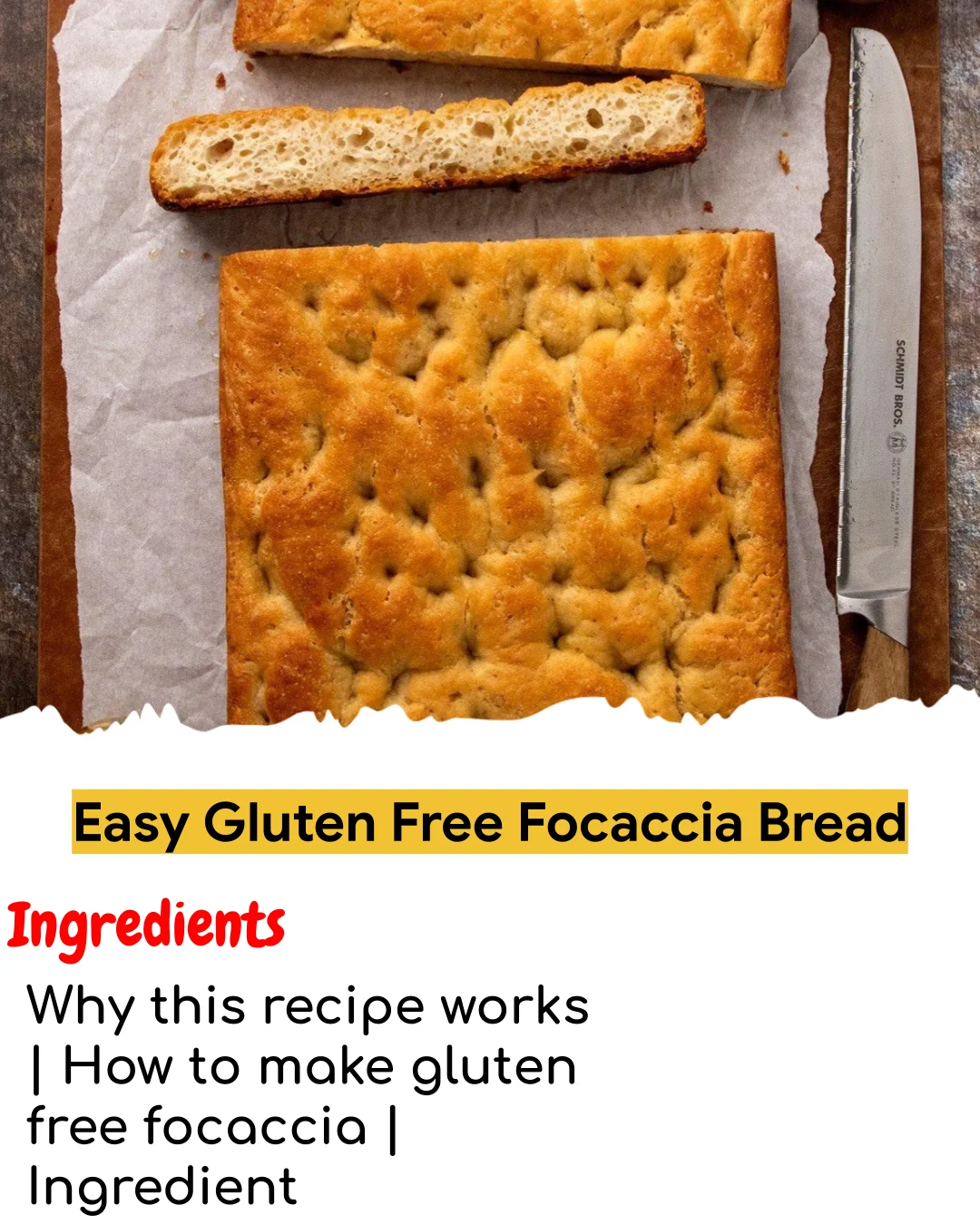
Rectangular loaf of golden flat bread on parchment paper, with three thick.
slices cut from the top and arranged above the loaf. A serrated bread knife.
rests alongside, and a small wooden bowl holds one slice.
loaf of golden flat bread on parchment paper, with three thick slices cut from.
the top and arranged above the loaf. A serrated bread knife rests alongside, and.
a small wooden bowl holds one slice.
This gluten free focaccia bread has a crispy, flavorful outside and soft, airy.
crumb inside. Only 7 ingredients—including water!
EQUIPMENT
Stand mixer with paddle attachment (or food processor with plastic blade).
Large lidded bucket for proofing or large bowl with plastic wrap (optional).
9-inch x 13-inch x 2-inch baking pan.
INGREDIENTS
3 ¼ cups (455 g) King Arthur Flour Gluten Free Pizza Flour.
INGREDIENTS
3 ¼ cups (455 g) King Arthur Flour Gluten Free Pizza Flour.
Notes
* 2 teaspoons (6 g) instant yeast
* 1 tablespoon (9 g) kosher salt
* 2 ¼ cups (18 fluid ounces) warm water
* 1 teaspoon apple cider vinegar
* 3 tablespoons (42 g) extra virgin olive oil, plus more for drizzling
* 2 tablespoons (42 g) honey
* In the bowl of a stand mixer fitted with the paddle attachment, whisk
together the pizza flour and instant yeast until well-combined. Whisk in the
salt until evenly distributed.
* Add the water, vinegar, 3 tablespoons olive oil, and honey. Mix on low speed
with the paddle attachment until a very sticky batter-style dough forms.
* Turn the mixer to medium-high speed and mix for 4 minutes. The dough will
still be quite thin and very sticky, but should have thickened a bit.
* You can work with the dough right away, or allow it a cold rise first for
* For a cold rise, transfer the dough to a greased 2-quart proofing bucket with
tight-fitting lid or a bowl at least 2-quarts in volume, and cover tightly
with plastic wrap. Place the bucket or covered bowl in the refrigerator for
at least 1 hour and up to 2 days. It will expand, but remain very sticky.
* On baking day, if you’ve chilled the dough, or right after mixing, prepare
the dough for its (final) rise.
* Drizzle enough olive oil to cover the bottom of a 9-inch x 13-inch x 2-inch
pan with 1/8-inch of oil. Turn the pan slowly to spread it evenly around the
surface of the pan, including greasing the sides.
* Use a greased silicone spatula to scrape the dough out of the mixing bowl (or
proofing container if you refrigerated it) into the oiled pan.
* Drizzle the top of the dough lightly and your fingers generously with more
oil. Use your fingers to press and push the dough into a rectangle about
9-inches x 13-inches, filling the pan, in a single layer.
* For a more even layer, use an oiled bench scraper or cake turner to smooth
the top of the rectangle as much as you can.
* Cover the top of the pan with oiled plastic wrap and place it in a warm,
draft-free location to rise until at least doubled in size. This will take 2
* When the dough is nearly at the end of its rise, preheat your oven to 425°F.
* Uncover the pan with the risen dough, drizzle the top evenly with about 2
tablespoons of olive oil, then oil the tips of your fingers generously.
* Dimple the dough down to the bottom of the pan in about half-inch intervals from one short
* Drizzle the dough lightly with more oil if it isn’t already glistening. Place
the pan in the center of the preheated oven and bake for 15 minutes.
* Reduce the oven temp to 375°F, and bake until the bread is lightly golden
brown all over, most of the oil has been absorbed, and the internal
temperature an instant-read thermometer inserted in the center reads at least
205°F (another 20 to 25 minutes).
* If the top is browning too quickly, cover with aluminum foil until finished
* Remove the pan from the oven, remove any foil you’ve added, and place the
baking pan on a wire rack.
* Let the bread cool for 5 minutes in the pan. Remove the pan and place the
bread right on the rack to cool for another 30 to 45 minutes to let the
starches in the bread set.
* Slice with a large serrated bread knife and serve.
About the flour blend
I have made this recipe successfully using King Arthur Flour (“KAF”) Gluten Free
Pizza Flour, Caputo Fioreglut, and my gluten free bread flour
The KAF gluten free pizza flour makes the bread with the largest holes, and the
best interior texture.
Caputo Fioreglut makes smaller holes with great outside texture and the least
My bread flour blend browns the best and has the best overall flavor, but I
think would work better with another 1/4 cup (2 fluid ounces) additional water.
Nutritional information
Is approximate based on 1 of 6 equal individual servings, and does not include
olive oil used for drizzling.
Sodium: 1170mg | Potassium: 43mg | Fiber: 2g | Sugar: 6g | Vitamin C: 0.05mg |
Calcium: 5mg | Iron: 0.2mg
Nutrition information is automatically calculated, so should only be used as an
As with most gluten free breads, focaccia has perfect texture both inside and
out the same day that it’s made. If you have leftovers, wrap them tightly in
plastic wrap and storing in an airtight container on the counter for up to 2
For longer storage, I recommend you freeze the bread. After it’s completely
cooled, wrap slices bread tightly in freezer-safe wrap, and then place it inside
a zip-top bag before freezing for up to 2 months.
Defrost water and warm at 300°F in the toaster oven until it’s warmed through.
FLAVOR VARIATIONS/TOPPINGS
The olive oil and yeast development add a lot of flavor to this bread, but you
can also add other savory flavoring. Try mixing up to 1 tablespoon dried herbs
de Provence into the raw dough, add dried herbs on top of the risen bread, or
try one of these ideas:
* Top the risen dough with dried or fresh rosemary and flaky sea salt on top;
* Add sun-dried tomatoes, chopped garlic, pitted and sliced olives, and/or
roasted red peppers in the dimples after rising;
* Experiment with fresh herbs like fresh sprigs of rosemary or fresh basil and
Can I let the dough rise overnight in the refrigerator?
Yes, you can let dough begin its final, shaped rise in the refrigerator
overnight. Remove it from the refrigerator and let it finish its rise, still
covered, at room temperature until it’s fully doubled before baking.
What if I can’t use King Arthur Flour’s GF Pizza Flour?
Try Caputo Fioreglut flour or my gluten free bread flour blend, using Better
Batter’s original blend with added whey protein isolate and Expandex.
Can I use this as a pizza crust base?
Sure! Let it bake for the first 15 minutes at 425°F as directed, then another 10
minutes at 375°F. Remove the pan from the oven, work quickly to add your pizza
toppings gently, and return the pan to the oven to finish baking.
Can I use a “regular” gluten free flour blend?
No, a “regular” all purpose gluten free flour blend doesn’t provide enough
structure to create or hold a high enough rise to make a focaccia-style bread
Can I make a smaller batch of bread?
Yes! You can cut all of the ingredients in half servings to 3 servings, and bake in an 8-inch square pan. The final bake at
375°F will be shorter.
What if I don’t have a stand mixer?
You can try using a food processor fitted with the plastic blade and pulsing the
dough until smooth. Be careful not to process for too long or the dough will
warm. Otherwise, try mixing the dough vigorously using a Danish dough whisk in a
large mixing bowl until you have a very smooth dough, but I can’t promise
results. Begin with a half recipe to avoid wasting ingredients.
Words gluten free herb focaccia bread below image of stack of 3 slices of
gluten free herb focaccia bread below image of stack of 3 slices of focaccia