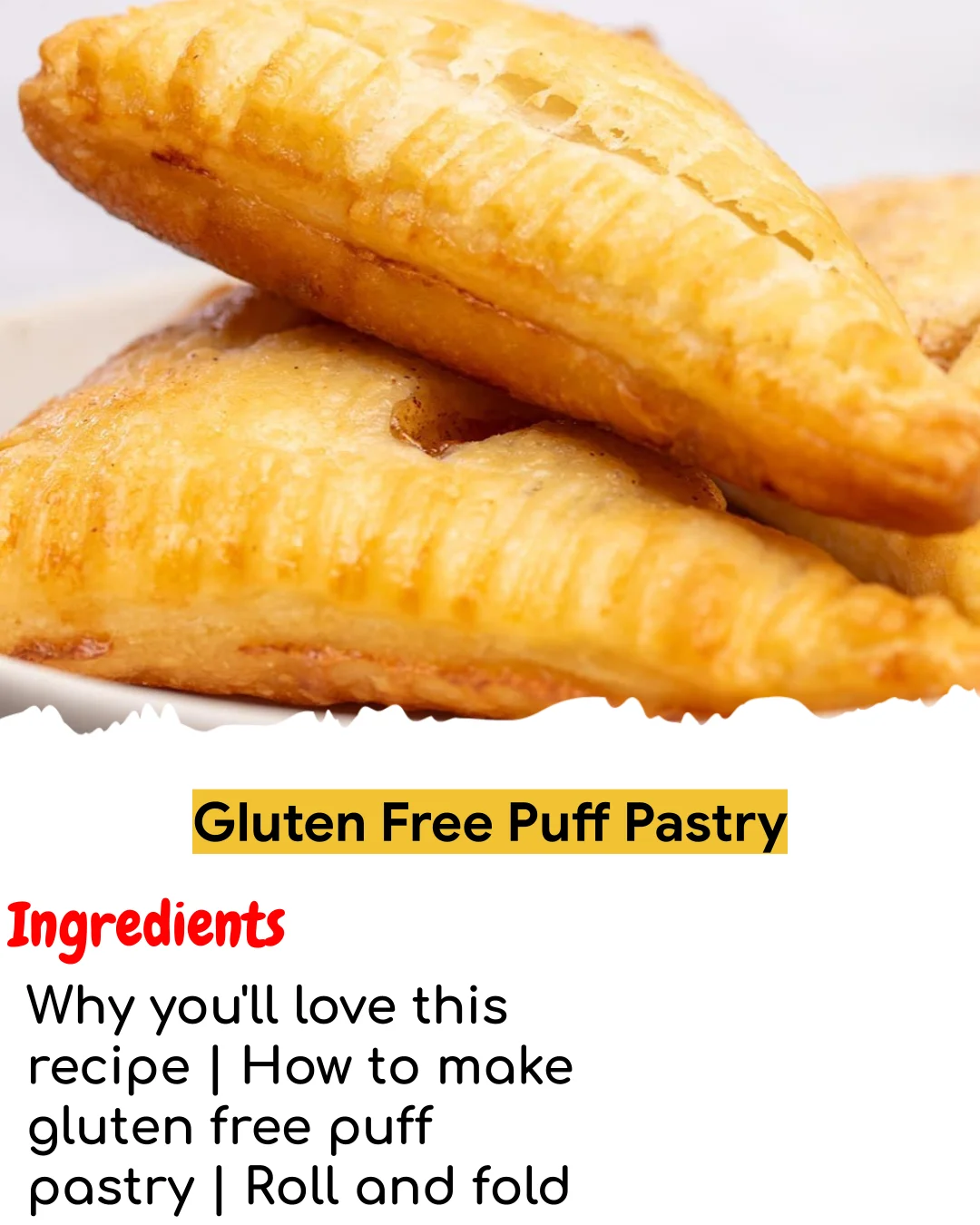
Cooking and Serving: 3 hours hrs | 3 sheets (equivalent)
Ingredients
Why you’ll love this recipe | How to make gluten free puff pastry | Roll and fold the dough (lamination)
Description
Prep Time: 1 hour hr | Total Time: 3 hours hrs | Servings: 3 sheets (equivalent)
Ingredients
Why you’ll love this recipe
How to make gluten free puff pastry
Roll and fold the dough (lamination)
Expert Tips
Ingredient substitutions
How to use this dough
Instructions
HOW TO MAKE GLUTEN FREE PUFF PASTRY
Puff pastry is made in two parts: the base dough and the butter packet. The.
dough is a simple mix of flour, water, and a bit of butter. The butter packet is.
really just butter, with a touch of flour.
You’ll prepare each part separately, then combine them into one stackable.
dough—the foundation for all those flaky layers.
MAKE THE BASE DOUGH
The base dough surrounds the butter packet and holds the structure—just like.
gluten free pie crust.
Whisk the flour blend and salt.
Toss in cold, chopped butter and press each piece flat between your fingers.
Add ice water a bit at a time, just until the dough holds together.
Press into a disk, wrap tightly, and chill.
Steps to make the dough in metal mixing bowl
to make the dough in metal mixing bowl.
MAKE THE BUTTER PACKET
For the butter packet, you’ll shape cold butter into a flat, even square that’s.
Cut 2 sticks of cold butter into 8 equal chunks.
Arrange into a 2-by-4 grid on a floured surface. Dust with more flour.
Pound and roll the butter until the pats press together.
Fold and roll again until you have a cohesive 4-inch square—cold but pliable.
Chunks of butter with some flour in one image, pressed together.
of butter with some flour in one image, pressed together.
Time to bring the dough and butter together
Roll the base dough into a 6-inch square.
Place the butter packet in the center, turned 45° like a diamond. Lightly.
Set the butter aside.
Light tan disk of the dough on light tan pastry board sprinkled with flour.
tan disk of the dough on light tan pastry board sprinkled with flour.
Roll out the 4 corners of the dough from each scored edge, creating flaps.
Return the butter packet to the center. Fold the flaps over it to seal, like.
Rolled out dough with flat yellow butter square on top, and then dough wrapped.
out dough with flat yellow butter square on top, and then dough wrapped around.
ROLL AND FOLD THE DOUGH (LAMINATION).
Lamination is what builds puff pastry’s signature layers. With each.
“turn”—rolling and folding—you multiply those layers exponentially.
Each turn: Roll the dough into a rectangle, then fold it in thirds like a.
business letter. That’s one turn.
Total turns: Do 6 turns total, chilling the dough for 30 minutes after every.
To use right away: Complete all 6 turns, chilling in between. After the final.
chill, roll the dough out to your desired thickness and use it to make a tart,.
turnover, or other pastry.
To use later: Complete only 4 turns, wrap tightly, and refrigerate. Later,.
before baking, let the dough warm just enough to roll smoothly, then finish the.
last 2 turns and chill once more.
Dough rolled into a pastry board, folded in thirds, with 4 knuckle markings.
rolled into a pastry board, folded in thirds, with 4 knuckle markings.
EXPERT TIPS
Cold butter is what creates puff pastry’s flaky layers. As it hits the hot oven,.
the butter releases steam and lifts each sheet of dough. If it melts too soon,.
But don’t let the dough crack.
If your dough breaks as you roll or wrap, it’s likely too cold. Let it warm.
slightly until pliable—just enough to bend, not melt.
Start with less and add only as needed. If you go too far, sprinkle in a touch.
of flour to rebalance.
Lamination requires precision. After every two turns, press a floured knuckle.
into the dough to mark your place—2 marks for 2 turns, 4 for 4, and so on.
More turns don’t mean more flake. After 6, the butter layers get too thin to.
lift the dough, and you’ll lose that airy texture.
The dough recipe uses the bare minimum flour for tenderness, so it can handle a.
sprinkling of flour during shaping. If it gets sticky or the butter starts.
peeking through, dust lightly and keep rolling.
INGREDIENT SUBSTITUTIONS
To make it dairy free:.
Swap the butter for a firm vegan butter like Melt or Miyoko’s Creamery. Just.
note—they’re softer than dairy butter, so your layers may be a bit less defined.
Avoid Cup4Cup flour if you’re dairy free, since it contains milk powder.
Use filtered, ice-cold water (measure before adding ice). Avoid spring or.
sparkling water, which can leave off flavors or impact texture.
Overhead image of golden brown pastry square with strawberries, blueberries and.
raspberries in center.
image of golden brown pastry square with strawberries, blueberries and.
raspberries in center.
HOW TO USE THIS DOUGH
This pastry works beautifully in both sweet and savory recipes:.
Make an open-face apple tart or use it as a crust for a rustic gluten free.
Try it as the base for a gluten free asparagus tart.
golden topper for gluten free chicken pot pie.
Cut and fill with pastry cream or whipped cream and berries for an elevated.
gluten free strawberry shortcake.
GLUTEN FREE PUFF PASTRY RECIPE
Chilling time: 2 hours hrs.
Total Time: 3 hours hrs.
Yield: 3 sheets (equivalent).
light brown gluten free apple turnovers made from gluten free puff pastry.
brown gluten free apple turnovers made from gluten free puff pastry.
Buttery, flaky gluten free puff pastry made easy with just 4 ingredients. Follow.
the step-by-step method for light, crisp layers every time—no guesswork, no.
EQUIPMENT
French rolling pin the kind that tapers on the.
ends, not the the kind with handles.
Metal bench scraper or knife or other straight edge.
FOR THE BASE DOUGH
2 cups (280 g) all purpose gluten free flour blend.
FOR THE BASE DOUGH
2 cups (280 g) all purpose gluten free flour blend.
Notes
* 1 teaspoon xanthan gum, omit if your blend already contains it; use a
* ¾ teaspoon kosher salt
* 4 tablespoons (56 g) unsalted butter, diced and kept cold
* ½ cup (4 fluid ounces) cold water, iced (ice doesn’t count in volume
measurement), plus more as necessary
FOR THE BUTTER PACKET
* 4 tablespoons (35 g) all purpose gluten free flour blend
* 16 tablespoons (224 g) unsalted butter, very cold
FIRST, MAKE THE BASE DOUGH.
* In a large bowl, place the 2 cups flour and salt, and mix or whisk to combine
well. Add the chopped unsalted butter and toss to combine. Press each chunk
of butter flat between your thumb and forefinger.
* Create a well in the dry ingredients, and add 1/2 cup of ice water to the
center. Stir the mixture to combine. Add more ice water until the dough stays together when pressed.
* Press the dough into a ball, place it onto a piece of plastic wrap and wrap
tightly. Place in the refrigerator to chill until firm while you make the
MAKE THE BUTTER PACKET.
* Dust a sheet of parchment paper or bare flat surface with 2 tablespoons of
flour. Chop the two sticks of butter each chunks of 2 tablespoons each. You’ll have 8 pats of butter.
* Arrange the pats of butter on top of the flour into 4 groups of 2 pats,
touching one another, making a grid 2 wide with the remaining 2 tablespoons flour.
* Using a French rolling pin, pound the butter to begin to flatten it and to
press the pats of butter together. Press and roll the rolling pin until the
pats join together and make one butter packet about 1/2-inch thick,
sprinkling lightly with extra flour as necessary to prevent sticking.
* If the butter starts to get greasy, sprinkle it lightly with flour, and
refrigerate it until it firms up.
* Fold the butter in half, and roll and pound it again until flat, and repeat
the process until you have a butter packet that is about 4-inches square.
* Wrap the butter packet tightly in plastic wrap and place it in the freezer to
chill for about 5 minutes, or in the refrigerator for about 20 minutes, or
until beginning to firm.
COMBINE BASE DOUGH AND BUTTER PACKET.
* Remove the chilled base dough from the refrigerator, and place it on a
lightly floured surface. Sprinkle lightly with more flour, and press and roll
the dough until it is smooth, folding it over on itself as necessary.
* Press it into about a 6-inch round. Unwrap and place the chilled butter
packet in the center of the round of dough.
* Lightly score the perimeter of the butter packet, and set the butter packet
* Dust the top of the dough once more with flour, and roll out the dough from
the 4 scoring marks and out, away from the center of the dough, to create 4
* Dust with more flour as necessary to prevent the rolling pin from sticking to
the dough and move the dough frequently.
* Place the butter packet back in the center of the dough, and fold the 4 flaps
onto the butter like you would the bottom of a cardboard box. Press the dough
around the butter packet to seal it in.
COMPLETE “TURNS” 1 AND 2.
* Sprinkle the top of the dough with flour, and roll the dough away from you
into a long rectangle that is about 5-inches wide x 12-inches long.
* Whenever you’re handling the raw dough, sprinkle it lightly with flour to
prevent sticking, and shift and turn the dough frequently. Starting at a
short side, fold the rectangle in thirds as you would a business letter. This
* You will do two turns at a time, and then wrap and refrigerate the dough in
* Turn the dough 90° so the short side of the folded dough is facing you. Roll
the dough away from you again into another long rectangle, in approximately
the same size and shape as before (5 inches x 12 inches).
* Fold in the same manner, once again, starting at a short side and folding in
thirds like you would a business letter
* You have just completed the first two “turns.” With a floured knuckle, make
two impressions on the dough, to represent the completion of two turns.
* Cover the dough with plastic wrap tightly and place in the refrigerator for
COMPLETE THE 3RD & 4TH TURNS.
* Remove the chilled dough from the refrigerator. Unwrap it, and lightly flour
the outside once again.
* With a short side of the folded dough facing you, roll away from you and into
a long rectangle the same size as before, about 5 inches wide x 12 inches
long. This is turn #3.
* Turn the dough 90° so the short side of the folded dough is facing you.
Sprinkle the dough lightly with extra flour if any spots become sticky. Roll
the dough away from you again into another long rectangle, in approximately
the same size and shape as before (5 inches x 12 inches).
* Fold in the same manner, once again, starting at a short side and folding in
thirds like you would a business letter.
* You have just completed the second two “turns” (numbers 3 and 4). With a
floured knuckle, make four impressions on the dough, to represent the
completion of 4 turns in total so far.
* Cover the dough with plastic wrap tightly and place in the refrigerator for
* If you plan to use the dough today, continue on to the final steps of
preparation. If not, keep the dough, wrapped very tightly, in the
refrigerator until about 1 hour before you’d like to use it. When you’re
ready, remove the wrapped dough from the refrigerator, and resume the recipe
COMPLETE THE FINAL 2 TURNS (#5 AND #6).
* Remove the chilled dough from the refrigerator. If the dough is too stiff to
roll, allow it to sit at room temperature for 15 to 20 minutes. When it’s
ready, unwrap it, and lightly flour the outside once again.
* Turn the dough 90° so the short side of the folded dough is facing you.
Sprinkle the dough lightly with extra flour if any spots become sticky. Roll
the dough away from you again into another long rectangle, in approximately
the same size and shape as before (5 inches x 12 inches).
* Fold in the same manner as before, starting at a short side and folding in
thirds like you would a business letter. This is turn #5.
* One final time, turn the dough 90° so the short side of the folded dough is
facing you. Sprinkle the dough lightly with extra flour if any spots become
sticky. Roll the dough away from you again into a final long rectangle, in
approximately the same size and shape as before (5 inches x 12 inches).
* Fold in the same manner as before, starting at a short side and folding in
thirds like you would a business letter. You have completely the final turn.
* Wrap tightly and refrigerate for at least another 30 minutes.
* It is now ready to be rolled out and used in any recipe that you would
otherwise use conventional puff pastry. This full recipe makes the equivalent
of about 3 sheets of conventional frozen packaged puff pastry.
* Use the fully prepared puff pastry sheet anywhere you would have used a
For best results, use Better Batter’s original blend or my Nicole’s Best
multipurpose blend. Bob’s Red Mill 1-to-1 should also work—but you’ll need to
add at least an extra ½ teaspoon xanthan gum to the base dough.
I don’t recommend Cup4Cup anymore, since the new formula doesn’t perform as
well. Prefer DIY? Use one of my mock all purpose gluten free flour blends
This recipe makes about 2 pounds of dough—enough for 3 sheets of puff pastry,
rolled to 10×10-inch squares. One sheet is the serving size used for the
Use in place of pie crust or any other pastry in:
Trans Fat: 3g | Cholesterol: 201mg | Sodium: 677mg | Potassium: 26mg | Fiber: 4g
| Sugar: 0.1g | Vitamin A: 2332IU | Calcium: 24mg | Iron: 0.02mg
Nutrition information is automatically calculated, so should only be used as an
Pastry dough rolled out and folded in thirds like a business letter on light tan
dough rolled out and folded in thirds like a business letter on light tan pastry
Let baked goods cool completely, then wrap tightly. Store at room temperature
for up to 2 days, or refrigerate for another 2 days after that.
To refresh: Sprinkle lightly with lukewarm water and warm in a 300°F oven for
If shaped and ready to bake, wrap tightly and freeze for up to 3 months. Bake
from frozen—just add a few extra minutes to the bake time.
After 4 turns, wrap tightly and refrigerate for up to 5 days or freeze for 3
months. When ready to use, let the dough warm slightly until rollable, then
complete the final 2 turns, chill again, and use.
What is the difference between traditional vs. rough puff pastry?
base dough, then laminated with multiple turns and chill periods.
Rough puff, or quick puff, skips the butter packet and mixes chunks of cold
butter directly into the dough. It’s faster, but doesn’t have as many distinct
layers, more like gluten free biscuits
How much puff pastry does this recipe make?
You’ll get about 2 pounds of dough—enough for 3 sheets, each around 10×10
inches. That’s about 30% more than a typical 2-sheet box from the store.
Yes—just adjust the “yield” in the recipe card. Keep in mind the step-by-step
instructions won’t change, so you’ll need to scale sizes proportionally.
Are there store-bought options?
A few brands like Schär and GeeFree make GF pastry, but I haven’t tested them
myself—so I can’t say how they compare.
Why didn’t my puff pastry rise?
The most common issue is warm butter—it may have melted into the dough instead
of staying in distinct layers.
Other possible causes: too many turns (more than 6), or re-rolling after
refrigerating or freezing, which can compress the layers.
Why is my pastry oily?
Warm butter is usually the culprit. If it softens too much during shaping, it
melts into the dough and leaks during baking.
Close up view of spinach puff pastry on brown paper
up view of spinach puff pastry on brown paper
A close up overhead view of a spinach puff pastry on white surface
close up overhead view of a spinach puff pastry on white surface