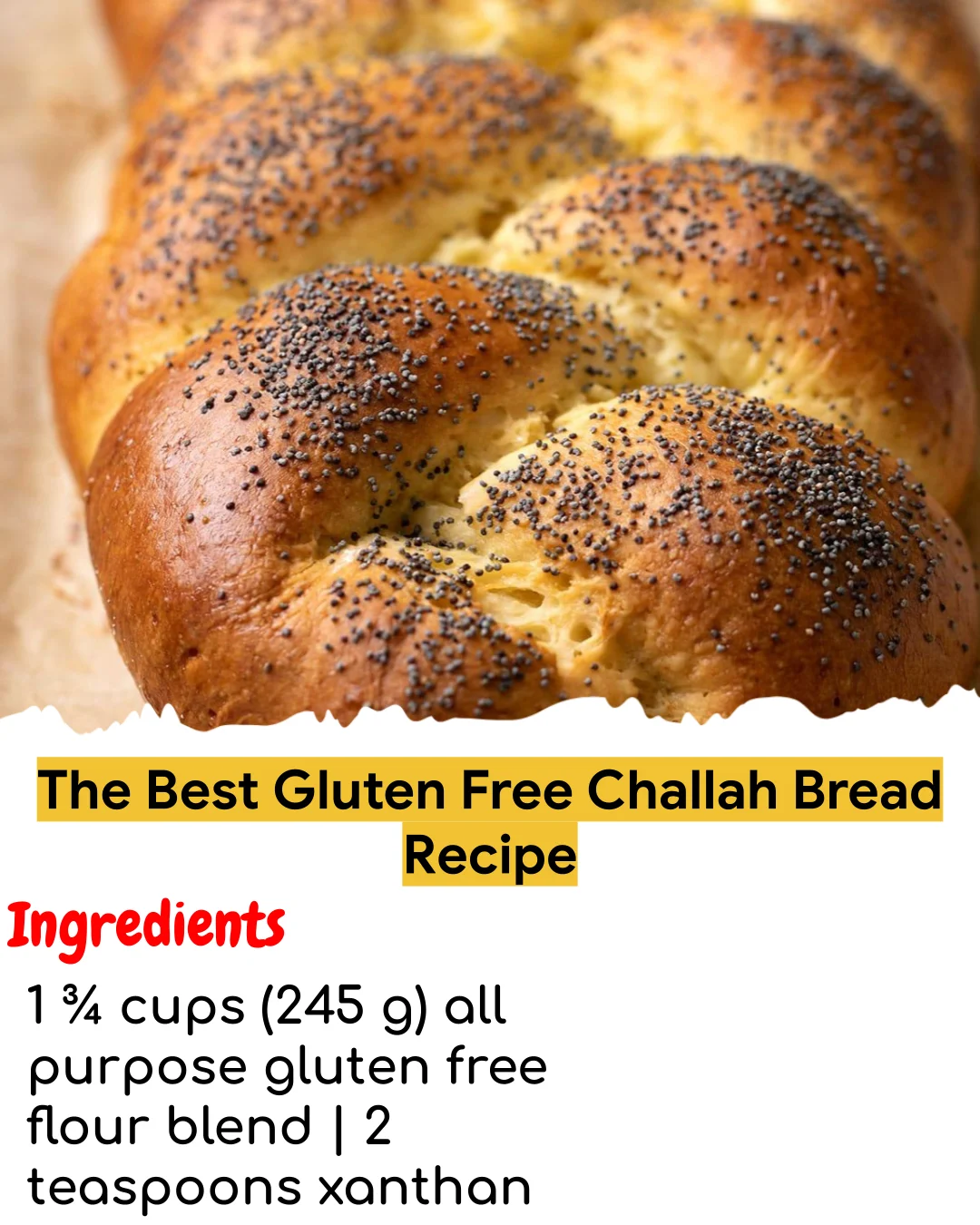
Cooking and Serving: 75 minutes | 8 slices
Ingredients
1 ¾ cups (245 g) all purpose gluten free flour blend | 2 teaspoons xanthan gum, omit if your blend already contains it | ⅝ cup (75 g) tapioca starch/flour
Description
Prep Time: 30 minutes | Cook Time: 45 minutes | Total Time: 75 minutes | Servings: 8 slices
Ingredients
1 ¾ cups (245 g) all purpose gluten free flour blend
2 teaspoons xanthan gum, omit if your blend already contains it
⅝ cup (75 g) tapioca starch/flour
1 ⅔ teaspoons (5 g) instant yeast, (See Recipe Notes)
¼ cup (50 g) granulated sugar
2 teaspoons (6 g) kosher salt
¾ cup (6 fluid ounces) lukewarm water, plus a teaspoon or so more if
4 tablespoons (56 g) extra virgin olive oil
3 (75 g) egg yolks, at room temperature
2 tablespoons (42 g) honey
Egg wash, 1 large egg, at room temperature, beaten with 1 tablespoon water
Poppyseeds or sesame seeds, for sprinkling (optional)
Instructions
MAKE THE CHALLAH BREAD DOUGH
In the bowl of a stand mixer fitted with the paddle attachment, place the.
flour blend, xanthan gum, tapioca starch/flour, instant yeast, and granulated.
sugar. Whisk to combine well.
Add the salt, and whisk again to combine.
Add a bit more than 1/2 cup of the water, olive oil, egg yolks, and honey.
Using the paddle attachment, beat vigorously.
With the mixer running, add as much of the remaining water as necessary for.
the dough to smooth out. In a warm, humid environment, it may take a bit less.
than the full 3/4 cup of water. In a dry, cold environment, it may take less.
Watch the texture very carefully
The dough mixture will come together in a clump and then smooth out and stick.
to the sides of the bowl. Keep beating until it begins to look whipped, and.
the color lightens a bit (about 6 minutes total).
Transfer the mixture to a lightly oiled bucket or bowl with a very.
tight-fitting lid. Place the container in the refrigerator, tightly sealed,.
for at least an hour and up to 2 days.
SHAPE THE BRAIDED GF CHALLAH
When you’re ready to bake, turn out the chilled dough onto a surface very.
very lightly dusted with tapioca starch/flour.
Sprinkle the top very very lightly with more starch, and divide the dough.
into 3 equal portions. Do not add much starch, or your bread will not rise.
If the dough seems too hard to handle and you’re tempted to add even more.
starch, place it back in the container and let it chill in the refrigerator.
for at least another hour.
Working with one piece at a time, knead the dough in your clean, dry hands,.
without adding any additional flour of any kind, pinching any seams that.
Begin working the dough into a cylindrical shape, pinching any gaps together,.
fanning your hands out toward the edges to lengthen the strand.
Rolling back and forth, create strands about 15 inches long from end to end.
that taper slowly from the center to each end, with very tapered ends.
Sprinkle each strand lightly with more tapioca flour on the outside of the.
cylinder to smooth the surface, then set it aside.
Place the 3 strands on a lightly floured surface parallel to one another and.
about 5 inches apart from one another. Gather the tapered ends on one side.
together, pinch them securely and tuck the very end under the knot.
Plait the 3 strands as you would any 3-strand braid. Do not pull the strands,.
as they’ll fray. Just place them on top of one another as you work toward.
from one end to the other.
Beginning as close as possible to the bound end, place one outside strand.
across the center strand, exchanging the center for the outside strand you.
just moved to the center.
Repeat with the other outside strand and center strand. Repeat the process,.
alternating one side and then the other until you reach the end. Tuck the end.
under as you did the other side.
Placing your hands carefully under each side of the braided loaf, carefully.
lift the braid onto a lined baking sheet. Press the finished braid gently on.
each ends toward center to shorten the length a bit.
Sprinkle the top of the braid lightly with more tapioca starch and brush off.
excess from the valleys between braids.
LET THE BREAD RISE
Cover the braid securely with plastic wrap, and place the loaf in a warm,.
draft-free location. Allow the loaf to rise until it’s at least 150% its.
original size (anywhere from 45 minutes to hours).
If any of the tops of the strands begin to separate from one another as the.
dough rises, try to smooth and pinch them closed. When the dough is nearing.
the end of its rise, preheat your oven to 350°F.
BAKE THE BREAD
Uncover the risen bread and brush the tops and sides of the braids very.
generously with the egg wash. Avoid letting the egg wash pool in between the.
braids. Sprinkle the top evenly with the optional seeds.
Place the baking sheet in the center of the preheated oven. Bake for 30.
minutes, rotate the baking sheet 180° and reduce the oven temperature to.
Continue to bake for about 15 minutes, or until the bread bounces back when.
pressed on a center braid and the internal temperature is at least 190°F on.
an instant read thermometer.
Remove the bread from the oven and allow it to cool on the baking sheet for.
at least 20 minutes before transferring to a wire rack too cool completely.
Notes
where they should be!
WHAT IS THE TASTE AND TEXTURE OF GOOD CHALLAH?
Challah bread is a highly enriched bread, made with plenty of oil, egg yolks,
and some sugar, too. That’s how you get that thin, tender, dark brown crust and
the rich aroma of deeply browned bread.
Challah is not a high-rising, fluffy bread. Instead, it’s meant to hold its
shape after being braided, and to have a more closed, chewy crumb. It tastes
slightly, but not overly, sweet and tastes pleasantly eggy, like a cross between
Baked braided challah bread with poppyseeds on top on brown paper lining metal
braided challah bread with poppyseeds on top on brown paper lining metal baking
HANDLING THE DOUGH WITHOUT TOO MUCH FLOUR
Challah dough must be handled quite a lot, since it’s separated into 3 parts,
each part is rolled into a long strand, and then all 3 strands are braided
together. This isn’t a very wet dough, since wet batter-style gluten free bread
dough can’t be shaped, so it’s very important not to add much more of any type
of flour when you shape the dough.
The dough is prepared properly container, and then dusted very very lightly with tapioca starch. Both of these
steps are designed to make the dough easier to handle without kneading in more
When you’re preparing bread dough and you add more flour, the more you add, the
lower the hydration ratio of the bread is. If the bread dough is not properly
hydrated, it won’t rise well.
If this dough were too wet, you couldn’t possibly handle it enough to braid it.
Plus, the dough would never hold its shape during rising and baking. We need to
find that sweet spot, where you can handle and shape the bread with a light
If the dough seems too hard to handle and you’re tempted to add even more
starch, place it back in the container and let it chill in the refrigerator for
at least another hour. The dough will absorb more of the moisture, but it will
still be locked inside. Plus, cold dough is less sticky
Ball of raw challah dough in 1 liter round plastic container on marble surface
of raw challah dough in 1 liter round plastic container on marble surface
BRAIDING GLUTEN FREE CHALLAH BREAD STRANDS INTO A LOAF
You can braid gluten free challah bread in a 3-strand, 4-strand, or even a
6-strand loaf. The braiding technique begins the same way as any braided bread
recipe—but the handling of the dough requires some special care.
I’ve used a 3-strand braid here because it’s the simplest (if you can braid a
ponytail, you can braid a 3-strand challah!). If the three strands side (
* 1 over 2, and return old 2 to 1 spot;
* 3 over 2, and return old 2 to 3 spot;
* Repeat until you reach the end of the braid.
Do not ever pull on the strands, though. They must not fray. Place them where
you want them, overlapping them carefully and with intention.
Of course, if you’d prefer, you can use a challah mold pan and place the
unshaped dough into the pan to rise and then bake.
Three strands of raw gluten free challah bread dough being joined, then braided,
strands of raw gluten free challah bread dough being joined, then braided, and
TIPS FOR MAKING THE BEST GLUTEN FREE CHALLAH
START WITH ROOM-TEMPERATURE INGREDIENTS
Unlike many gluten free yeast bread recipes that call for warm ingredients to
activate the yeast quickly, this recipe calls for ingredients at room
temperature. We then let the bread rest in the refrigerator so that the liquids
are absorbed into the flour.
USE THE RIGHT AMOUNT OF SUGAR
Sugar in baking isn’t just for sweetness. In fact, it’s most valuable here in
this recipe, and in many others, for tenderizing the bread, and keeping it fresh
The sugar here feeds the yeast so that it can grow. It also helps aid the
browning and results in that deep brown challah crust.
Closeup image of raw braided challah dough with egg wash and poppyseeds on brown
paper lining metal baking pan
image of raw braided challah dough with egg wash and poppyseeds on brown paper
lining metal baking pan
REFRIGERATE YOUR GF CHALLAH BREAD DOUGH FOR EASIER HANDLING
Refrigerating the raw dough in a tightly sealed container makes handling the
First, it allows the flours time to absorb the liquid. You don’t sacrifice any
liquid, which the bread needs for rising and for texture, but the dough is less
sticky. Second, refrigerating the dough makes it colder, making it easier to
If you don’t have time to refrigerate the dough, you can still work with it. It
will just be a bit harder to handle and more fragile.
GIVE YOUR GLUTEN FREE CHALLAH BREAD DOUGH TIME TO RISE
Yeast bread dough rises faster in warm (not hot) temperatures closer to 80°F
that aren’t drafty. It rises more slowly in colder temperatures.
It also must be covered properly as it rises, so the moisture in the dough
doesn’t evaporate. If the moisture evaporates, the dough will be too stiff and
the yeast will not grow properly.
ADD AN EGG WASH BEFORE BAKING
An egg wash is just a beaten egg with either water or milk. Here, we’re using
water to keep it dairy-free easily.
After the braided raw dough has risen, we brush the egg wash on top of the
braids and all along the perimeter. The egg wash helps the braids brown
beautifully and keeps the dough from breaking through the surface during its
Avoid letting the egg wash pool in the space between the braids. We want that
portion to rise freely.
Partially sliced loaf of gluten free challah bread on cutting board with black
sliced loaf of gluten free challah bread on cutting board with black background
HOW TO SERVE THIS CHALLAH BREAD SUBSTITUTE
This challah bread is amazing in the center of your Jewish holiday meal. But you
don’t have to celebrate Jewish holidays to enjoy this gluten free challah!
Sliced thickly, this challah makes rich, eggy, lightly sweet gluten free French
find yourself snatching some slices from the loaf to ensure there are leftovers
for gluten free bread pudding
Try toasting a generous slice and topping it with light and fluffy scrambled
eggs. Or just a big schmear of cream cheese and a light sprinkling of chives.
HOW TO STORE AND FREEZE YOUR GLUTEN FREE BRAIDED BREAD
If you’re not planning to serve your bread right away, you can keep it fresh for
about 8 hours at room temperature. Just wrap it tightly in plastic and eliminate
as much air as possible.
For any leftover bread, be sure to slice it how you’d like to serve it, wrap it
tightly in the same manner, and freeze it. Defrost it one slice at a time in the
microwave or at room temperature, and refresh it in the toaster oven.
I don’t recommend freezing raw yeast bread, only baked yeast bread. If the
temperature drops too low, you may kill the yeast and waste all that hard work
GLUTEN FREE CHALLAH BREAD INGREDIENT SUBSTITUTION SUGGESTIONS
This challah is already dairy-free. Let’s talk about suggestions for making
CAN YOU MAKE THIS GLUTEN FREE CHALLAH BREAD WITHOUT EGGS?
It isn’t as easy to replace egg yolks as it is to replace whole eggs. You can
try using three tablespoons of vegan butter in place of the three egg yolks to
replace the fat of the yolks.
CAN YOU MAKE VEGAN GLUTEN FREE CHALLAH?
If you replace the egg yolks with vegan butter successfully, you’ll need to
replace the honey to have a recipe for gluten free vegan challah bread. In place
of honey, try using light corn syrup.
DOES IT MATTER WHICH GLUTEN FREE FLOUR BLEND YOU USE IN THIS GF CHALLAH RECIPE?
Yes! It matters a lot which gf flour blend you use. And it matters that you add
the additional 75 grams of tapioca starch/flour.
I highly recommend using Better Batter (or our DIY mock Better Batter style
the all purpose gluten free flour blend. It took me years to develop a reliable
gluten free challah bread recipe without using our gluten free bread flour
Don’t use Cup4Cup gluten free flour here, even though it is one of my favorite
blends. It’s simply too high in starch to produce proper bread that holds its
shape as intended (it would make a paler, fluffier, and more out-of-shape
loaf)—and browns properly here.
This recipe relies even more than usual on true precision in ingredient
selection, and in measurement accuracy. For reliable results like the photos
that taste amazing, you must use the flours specified, and you must measure by
Baked loaf of gluten free challah bread with poppy seeds on wooden cutting board
on brown cloth with bread knife
loaf of gluten free challah bread with poppy seeds on wooden cutting board on
brown cloth with bread knife
FAQS FOR THIS CHALLAH RECIPE
Is challah bread gluten free?
No. Traditionally, challah bread is made with wheat flour, along with lots of
dairy-free enrichments like egg yolks, oil, and honey or other sugars.
This bread is what you might think of as a challah bread substitute, since it’s
made wheat-free. But it’s a substitute that tastes just as it should—and no one
will know that it’s made with an all purpose gluten free flour blend
Is challah the same as brioche?
enriched breads, but they’re not at all the same.
Brioche is a richer, heartier bread than challah, and challah is best made
without butter, so it’s pareve
(neither milk nor meat, which can’t be mixed in kosher meal) and can be served
with any holiday meal.
How do I handle dough that is too wet to shape?
Resist the urge to add much more flour or starch! Try returning the dough to its
sealed container and placing it in the refrigerator to chill for at least
Why won’t my bread rise?
There are many reasons that you might have trouble getting a yeast bread to
rise. Here are some questions to ask yourself:
Did you use one of my recommended flour blends, measured Did you add more than a light dusting of extra flour on your dough during
Did you wait long enough? Overproofing is not a matter of too long a rise, but
too much of a rise. Sometimes a rise takes much longer than anticipated
depending on the temperature and humidity in your kitchen.
Is this gluten free challah bread dairy-free?
Yes, this gluten free challah bread is already dairy-free. It’s made with olive
oil instead of butter, and water instead of milk. If you want to replace the
olive oil, I recommend using vegan butter. Do not use a flavorless oil like
canola or vegetable oil, or the flavor will suffer.
Go Ad-Free
THE BEST GLUTEN FREE CHALLAH BREAD RECIPE
Prep Time: 30 minutes mins
Cook Time: 45 minutes mins
Resting and rising times: 2 hours hrs
Total Time: 3 hours hrs 15 minutes mins
braided gluten free challah bread on brown paper
gluten free challah bread on brown paper
This gluten free challah bread recipe is also dairy free, so it’s perfect for
any holiday table. It also makes amazing gf French toast, sandwiches, or bread
* 1 ¾ cups (245 g) all purpose gluten free flour blend
(I used Better Batter and recommend it highly here; please click thru for
appropriate blends you must choose carefully for results!)
* 2 teaspoons xanthan gum, omit if your blend already contains it
* ⅝ cup (75 g) tapioca starch/flour
* ¼ cup (50 g) granulated sugar
* 2 teaspoons (6 g) kosher salt
* ¾ cup (6 fluid ounces) lukewarm water, plus a teaspoon or so more if
* 4 tablespoons (56 g) extra virgin olive oil
* 3 (75 g) egg yolks, at room temperature
* 2 tablespoons (42 g) honey
* Egg wash, 1 large egg, at room temperature, beaten with 1 tablespoon water
* Poppyseeds or sesame seeds, for sprinkling (optional)
MAKE THE CHALLAH BREAD DOUGH
* In the bowl of a stand mixer fitted with the paddle attachment, place the
flour blend, xanthan gum, tapioca starch/flour, instant yeast, and granulated
sugar. Whisk to combine well.
* Add the salt, and whisk again to combine.
* Add a bit more than 1/2 cup of the water, olive oil, egg yolks, and honey.
Using the paddle attachment, beat vigorously.
* With the mixer running, add as much of the remaining water as necessary for
the dough to smooth out. In a warm, humid environment, it may take a bit less
than the full 3/4 cup of water. In a dry, cold environment, it may take less.
Watch the texture very carefully.
* The dough mixture will come together in a clump and then smooth out and stick
to the sides of the bowl. Keep beating until it begins to look whipped, and
the color lightens a bit (about 6 minutes total).
* Transfer the mixture to a lightly oiled bucket or bowl with a very
tight-fitting lid. Place the container in the refrigerator, tightly sealed,
for at least an hour and up to 2 days.
SHAPE THE BRAIDED GF CHALLAH
* When you’re ready to bake, turn out the chilled dough onto a surface very
very lightly dusted with tapioca starch/flour.
* Sprinkle the top very very lightly with more starch, and divide the dough
into 3 equal portions. Do not add much starch, or your bread will not rise
* If the dough seems too hard to handle and you’re tempted to add even more
starch, place it back in the container and let it chill in the refrigerator
for at least another hour.
* Working with one piece at a time, knead the dough in your clean, dry hands,
without adding any additional flour of any kind, pinching any seams that
* Begin working the dough into a cylindrical shape, pinching any gaps together,
fanning your hands out toward the edges to lengthen the strand.
* Rolling back and forth, create strands about 15 inches long from end to end
that taper slowly from the center to each end, with very tapered ends.
Sprinkle each strand lightly with more tapioca flour on the outside of the
cylinder to smooth the surface, then set it aside.
* Place the 3 strands on a lightly floured surface parallel to one another and
about 5 inches apart from one another. Gather the tapered ends on one side
together, pinch them securely and tuck the very end under the knot.
* Plait the 3 strands as you would any 3-strand braid. Do not pull the strands,
as they’ll fray. Just place them on top of one another as you work toward
from one end to the other.
* Beginning as close as possible to the bound end, place one outside strand
across the center strand, exchanging the center for the outside strand you
just moved to the center.
* Repeat with the other outside strand and center strand. Repeat the process,
alternating one side and then the other until you reach the end. Tuck the end
under as you did the other side.
* Placing your hands carefully under each side of the braided loaf, carefully
lift the braid onto a lined baking sheet. Press the finished braid gently on
each ends toward center to shorten the length a bit.
* Sprinkle the top of the braid lightly with more tapioca starch and brush off
excess from the valleys between braids.
* Cover the braid securely with plastic wrap, and place the loaf in a warm,
draft-free location. Allow the loaf to rise until it’s at least 150% its
original size (anywhere from 45 minutes to hours).
* If any of the tops of the strands begin to separate from one another as the
dough rises, try to smooth and pinch them closed. When the dough is nearing
the end of its rise, preheat your oven to 350°F.
* Uncover the risen bread and brush the tops and sides of the braids very
generously with the egg wash. Avoid letting the egg wash pool in between the
braids. Sprinkle the top evenly with the optional seeds.
* Place the baking sheet in the center of the preheated oven. Bake for 30
minutes, rotate the baking sheet 180° and reduce the oven temperature to
* Continue to bake for about 15 minutes, or until the bread bounces back when
pressed on a center braid and the internal temperature is at least 190°F on
an instant read thermometer.
* Remove the bread from the oven and allow it to cool on the baking sheet for
at least 20 minutes before transferring to a wire rack too cool completely.
For the instant yeast.
If you’d like use active dry yeast in place of instant yeast, you’ll need to
hydrate the yeast first in some water in the recipe. You’ll also need 25% more
active dry yeast, which is slightly over 6 grams, to replace 5 grams of instant
If you don’t have a stand mixer, I recommend making the dough in a food
processor fitted with the steel blade, but it’s not ideal and may easily lead to
overprocessing the dough. I don’t recommend a hand mixer, or trying to mix by
hand. Only a stand mixer will yield predictable results.
Nutrition information is automatically calculated, so should only be used as an