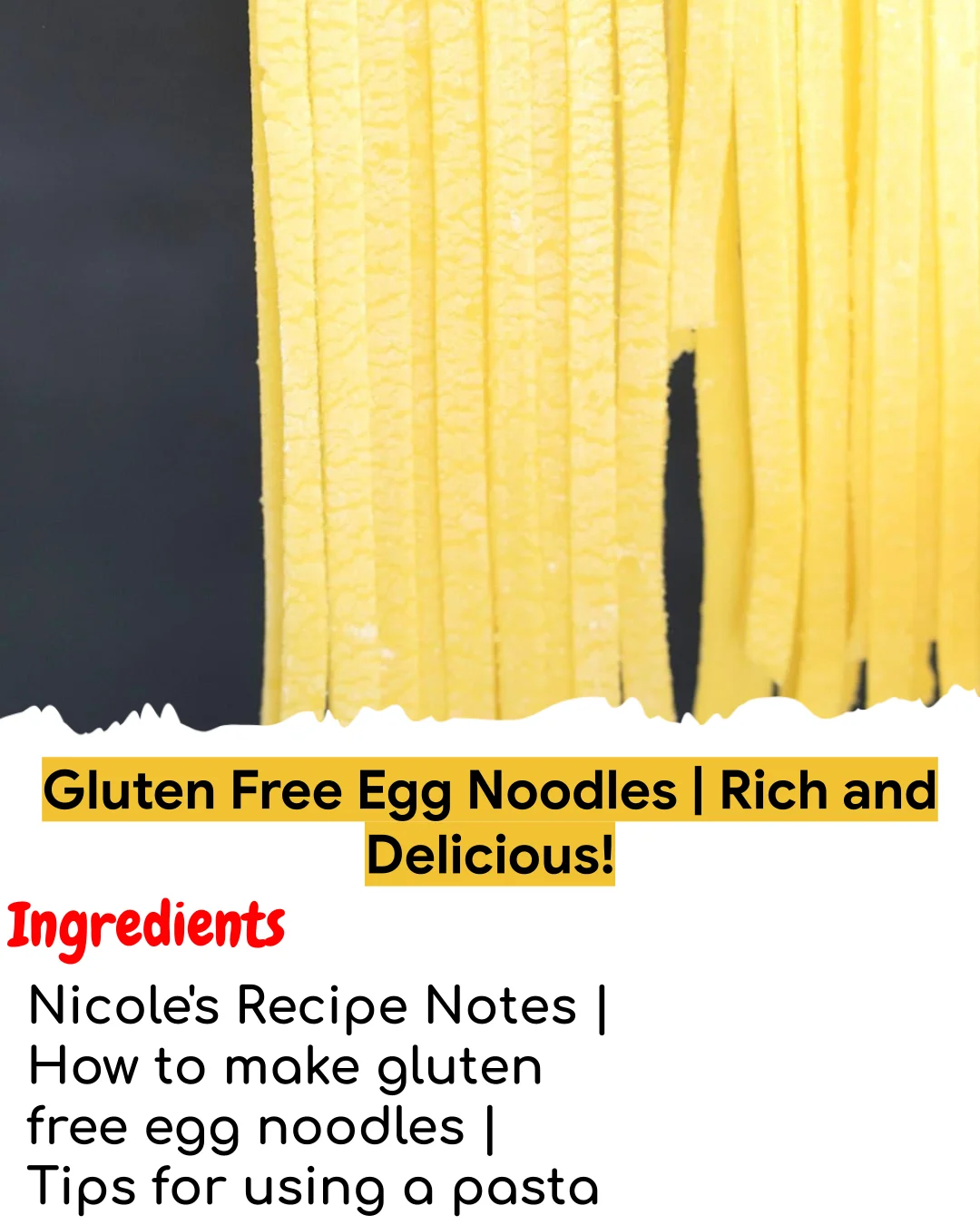
Cooking and Serving: 45 minutes | 14 ounces noodles
Ingredients
Nicole’s Recipe Notes | How to make gluten free egg noodles | Tips for using a pasta roller to make gluten free pasta
Description
Prep Time: 40 minutes | Cook Time: 5 minutes | Total Time: 45 minutes | Servings: 14 ounces noodles
Ingredients
Nicole’s Recipe Notes
How to make gluten free egg noodles
Tips for using a pasta roller to make gluten free pasta
Ingredient substitutions
Food processor fitted with steel blade
Hand crank pasta roller or stand mixer attachment optional
Pasta drying rack optional
1 cup (140 g) all purpose gluten free flour blend
½ teaspoon xanthan gum, omit if your blend already contains it
5 tablespoons (40 g) tapioca starch/flour
2 (100 g (weighed out of shell)) eggs, at room temperature
4 (100 g) egg yolks, at room temperature
1 tablespoon (14 g) extra virgin olive oil
Instructions
TO MAKE THE PASTA DOUGH
In the bowl of a food processor fitted with the steel blade, place the flour.
blend, xanthan gum, and tapioca starch/flour.
Place the top on the food processor, remove the hopper and add an egg or egg.
yolk to moisten the flours. Turn the food processor on low and continue.
adding the eggs and egg yolks slowly.
With the food processor still working, add the olive oil slowly. The dough.
will clump to one side of the food processor.
Continue to process until well-combined. The dough may still be a bit sticky.
Sprinkle a flat surface lightly with tapioca flour, and transfer the dough to.
the surface. Divide the dough into 3 equal parts.
Working with one part at a time, and covering the others with plastic wrap,.
knead the dough until smooth.
TO ROLL THE PASTA
Roll the dough on the dusted surface into a rectangle that’s a bit more than.
1/8-inch thick, dusting liberally with additional tapioca starch to prevent.
it from sticking to the surface or the rolling pin.
Move the dough frequently. The rectangle is easiest to handle if it’s no more.
than 4-inches wide and about 14-inches long.
TO CUT THE PASTA
Trim any rough edges and cut into strips with a pastry cutter, pizza wheel,.
or sharp knife. Hang the pasta on the spindles of a pasta drying rack, or.
dust lightly with more flour and roll into “nests” and place on a lightly.
floured surface. Repeat with the remaining dough.
TO ROLL THE PASTA WITH A PASTA MACHINE
Roll the dough thick, sprinkling liberally with additional tapioca starch as necessary to.
prevent sticking to the surface or the rolling pin.
Dust the rolled-out dough lightly with more tapioca starch, and feed the.
dough through a pasta machine with the rollers as far apart as possible.
(position “0” or “1”).
Feed the pasta through the rollers twice. Turn the dial one notch up, and.
Repeat the process, turning the dial one notch up each time, until you reach.
Any time the edges of the pasta sheet begin to feather or otherwise become.
uneven, dust both sides lightly with more tapioca starch before proceeding.
TO ROLL THE PASTA WITH A PASTA MACHINE
Roll the dough thick, sprinkling liberally with additional tapioca starch as necessary to.
prevent sticking to the surface or the rolling pin.
Dust the rolled-out dough lightly with more tapioca starch, and feed the.
dough through a pasta machine with the rollers as far apart as possible.
(position “0” or “1”).
Feed the pasta through the rollers twice. Turn the dial one notch up, and.
Repeat the process, turning the dial one notch up each time, until you reach.
Any time the edges of the pasta sheet begin to feather or otherwise become.
uneven, dust both sides lightly with more tapioca starch before proceeding.
Notes
* How to make gluten free egg noodles
* Tips for using a pasta roller to make gluten free pasta
* Ingredient substitutions
* Gluten Free Egg Noodles Recipe
Most homemade pasta is made with eggs. Gluten free egg noodles are similar to
our recipe for classic homemade gluten free pasta—but they’re much richer and
There are so many dried gluten free pastas to buy, and many of them are quite
good. But the only brand of dried gluten free egg noodles I’ve ever seen is
Manischewitz, and they’re as terrible in taste and texture as they are
And they’re really expensive.
There are even some fresh gluten free pastas that you can buy at stores like
Whole Foods—but they’re ridiculously expensive. I have picked up a package in
the store, considered it, then put it back so. many. times.
If you want good-tasting gluten free egg noodles, you’re going to have to make
them yourself. It takes a bit of time, but that fresh pot of homemade gluten
free chicken noodle soup
is going to be an instant family favorite.
Raw egg pasta dough in bowl of food processor on pink base
egg pasta dough in bowl of food processor on pink base
HOW TO MAKE GLUTEN FREE EGG NOODLES
This recipe for gluten free egg noodles has two steps: making the raw pasta
dough, and shaping it into noodles.
MAKE THE RAW PASTA DOUGH
To make the raw noodle dough, you only need a few ingredients, and a food
processor does all the work for you. First, place the all purpose gluten free
flour blend (including xanthan gum) and tapioca starch in the food processor,
and lock the top in place.
There are 2 eggs and 4 egg yolks in this recipe, and you’ll begin first egg or egg yolk to the flour just to moisten the flour. This way, when you
begin to add the remaining eggs and oil, you can keep the food processor running
but avoid the dry flours flying all over the place.
Next, with the food processor on low, add all of the remaining the eggs and egg
yolks, then olive oil, until the dough clumps and then smooths out. The dough
may be kind of sticky, so you’ll need to flour it lightly when you take it out
of the processor—but this is your pasta dough, and it’s already made!
Next, we will shape a single mound of pasta dough to turn it into actual
noodles. You can do this rolling pin and pastry cutter/wheel, or you can use a pasta machine if you have.
The pasta machine only makes it easier to press the dough into sheets, and then
cut those sheets into long, thin noodles. It isn’t essential to making these egg
To shape the noodles it’s a bit more than 1/8-inch thick. Keep moving the dough as you work, and dust
it regularly if it begins to stick. I like to use tapioca starch/flour for
shaping here, since it’s very lightly, and is less likely to absorb into the
pasta dough than an all purpose gluten free flour blend.
Try to roll the dough into a rectangle that’s about 4-inches wide x 14-inches
long, no longer, or it will become too difficult to handle. Trim jagged edges to
make clean noodles, then cut the rectangle into long, flat strips about 1/4-inch
wide and 14-inches long. For each 4 inches of width, you should get about 16
noodles. Without a pasta roller, you can’t make round spaghetti-style noodles,
SHAPE THE NOODLES WITH A PASTA ROLLER
To shape the noodles with a pasta roller, you’ll still have to begin the dough on a lightly floured surface with a rolling pin, but only until it’s
about 1/2-inch thick. Keep the dough moving, and dust it lightly with more flour
as you go to prevent it from sticking.
To roll the dough in a pasta machine or roller, you’ll feed it through the
machine twice with the rollers as far apart as possible (position “0” or “1”).
The purpose of this is to press the dough into an even layer before rolling it
thinner on the pasta roller.
To cut the rolled pasta sheets into noodles, dust with more flour, select the
roller that cuts into the shape you like, and feed the pasts through the roller
DRY THE SHAPED PASTA NOODLES
Whether you’ve shaped the pasta roller, you need to dry it before storing it or cooking it. If you attempt to
cook it right away, it won’t hold together very well.
To dry the noodles, hang them on the spindles of a pasta drying rack
, or dust lightly with more flour and roll into “nests”
and place on a lightly floured surface.
Hand catching rectangle of pasta dough coming out of pasta roller
catching rectangle of pasta dough coming out of pasta roller
TIPS FOR USING A PASTA ROLLER TO MAKE GLUTEN FREE PASTA
The numbers of your pasta roller machine correspond to the distance between the
roller bars. Begin with the lowest number (which may be “0” or may be “1”) for
the rollers in the position farthest from one another.
Go step Don’t skip any numbers.
Dust the dough repeatedly with more tapioca starch/flour as you go. If it begins
to feather on the edges, it’s likely too wet—or you’ve rushed the process.
Dust the dough, and go step gluten free Swedish meatballs
Hands on a small brown rolling pin rolling a piece of pasta dough on a round
on a small brown rolling pin rolling a piece of pasta dough on a round cloth
INGREDIENT SUBSTITUTIONS
CHOOSING YOUR GLUTEN FREE FLOURS
This is one of those simple, basic recipes that has only a few basic gluten free
flours, eggs, oil. The gluten free flour blend
Here, the flours matter even more. I highly recommend using Better Batter, or my
mock Better Batter blend (just click the link right above for the full recipe).
You can use (mock) Cup4Cup, but you’ll have better results with a blend that has
the fortitude of (mock) Better Batter.
Either way, you’ll need the addition of tapioca starch/flour. It helps provide
structure and stretch.
Yes, you still need to add tapioca starch/flour even though your all purpose
flour blend contains it as an element. I don’t recommend freelancing! Just
follow the recipe precisely as written.
If you can’t have tapioca starch/flour, then you’re unable to use (mock) Better
Batter or (mock) Cup4Cup either. And I’m afraid you can’t make this particular
Hand catching rectangle of pasta dough coming out of pasta roller
catching rectangle of pasta dough coming out of pasta roller
GLUTEN FREE EGG NOODLES WITHOUT EGGS?
These are egg noodles. I don’t recommend trying to make them without eggs.
I’m working on a recipe for gluten free udon noodles, which won’t have eggs. I
promise to link to that recipe here when it’s available!
If you can have eggs, but you’re just wondering about what to do with your
leftover egg whites since this recipe calls for additional egg yolks, save them
for gluten free angel food cake
Hand below pasta roller catching cut fresh angel hair pasta noodles
below pasta roller catching cut fresh angel hair pasta noodles
Go Ad-Free
GLUTEN FREE EGG NOODLES RECIPE
Prep Time: 40 minutes mins
Cook Time: 5 minutes mins
Yield: 14 ounces noodles
fettuccine gluten free egg noodles on drying rack
gluten free egg noodles on drying rack
Gluten free egg noodles, made with just 4 basic ingredients, can be made with a
* Food processor fitted with steel blade
* Hand crank pasta roller or stand mixer attachment optional
* Pasta drying rack optional
* 1 cup (140 g) all purpose gluten free flour blend
(I used Better Batter, and highly recommend it here; choose your blend
* ½ teaspoon xanthan gum, omit if your blend already contains it
* 5 tablespoons (40 g) tapioca starch/flour
* 2 (100 g (weighed out of shell)) eggs, at room temperature
* 4 (100 g) egg yolks, at room temperature
* 1 tablespoon (14 g) extra virgin olive oil
TO MAKE THE PASTA DOUGH.
* In the bowl of a food processor fitted with the steel blade, place the flour
blend, xanthan gum, and tapioca starch/flour.
* Place the top on the food processor, remove the hopper and add an egg or egg
yolk to moisten the flours. Turn the food processor on low and continue
adding the eggs and egg yolks slowly.
* With the food processor still working, add the olive oil slowly. The dough
will clump to one side of the food processor.
* Continue to process until well-combined. The dough may still be a bit sticky.
* Sprinkle a flat surface lightly with tapioca flour, and transfer the dough to
the surface. Divide the dough into 3 equal parts.
* Working with one part at a time, and covering the others with plastic wrap,
knead the dough until smooth.
* Roll the dough on the dusted surface into a rectangle that’s a bit more than
1/8-inch thick, dusting liberally with additional tapioca starch to prevent
it from sticking to the surface or the rolling pin.
* Move the dough frequently. The rectangle is easiest to handle if it’s no more
than 4-inches wide and about 14-inches long.
* Trim any rough edges and cut into strips with a pastry cutter, pizza wheel,
or sharp knife. Hang the pasta on the spindles of a pasta drying rack, or
dust lightly with more flour and roll into “nests” and place on a lightly
floured surface. Repeat with the remaining dough.
TO ROLL THE PASTA WITH A PASTA MACHINE.
* Roll the dough thick, sprinkling liberally with additional tapioca starch as necessary to
prevent sticking to the surface or the rolling pin.
* Dust the rolled-out dough lightly with more tapioca starch, and feed the
dough through a pasta machine with the rollers as far apart as possible
(position “0” or “1”).
* Feed the pasta through the rollers twice. Turn the dial one notch up, and
* Repeat the process, turning the dial one notch up each time, until you reach
* Any time the edges of the pasta sheet begin to feather or otherwise become
uneven, dust both sides lightly with more tapioca starch before proceeding.
TO CUT THE PASTA WITH A PASTA MACHINE.
* Trim the edges of the rectangle, dust lightly with more tapioca starch, and
feed through the pasta roller to cut into the ribbons you’ve selected.
* Hang the pasta on the spindles of a pasta drying rack, or dust lightly with
more flour and roll into “nests” and place on a lightly floured surface.
Repeat with the remaining dough.
* Bring a large pot of salted water to a rolling boil. Place the fresh pasta in
the water and cook, stirring to prevent the dough from clumping, for about 2
minutes or until it reaches al-dente texture.
* Toss with some olive oil or sauce, and serve immediately. If using the egg
pasta for chicken noodle soup, add to the soup and serve immediately.
MAKE-AHEAD INSTRUCTIONS.
* If you are using a pasta drying rack, I don’t recommend letting it dry for
more than about 1 hour (less if it’s very thin, like angel hair). It becomes
brittle and can be difficult to transfer without breaking. I recommend
boiling and eating it the same day.
* If you’re coiling your fresh pasta into nests, dust them with extra tapioca
starch/flour, and allow them to dry completely (a couple hours). Then, place
them in a rigid, freezer-safe container and freeze until ready to use. Boil
right from frozen until al-dente.
Tips for using a pasta roller.
Feathering along the edges will look just like jagged edges on the long sides of
the pasta rectangle. The pasta sheets will also usually appear patchy, and will
Just dust the dough liberally with more tapioca starch/flour as you go. And
don’t jump levels, as tempting as that is!
Nutrition information is automatically calculated, so should only be used as an
Are egg noodles gluten free?
No! Egg noodles are normally made with semonlina flour, which is a wheat-based
flour, one of the main sources of gluten. For gluten free egg noodles, you need
Do you need a food processor to make gluten free pasta dough?
Yes, I believe that you need a food processor to make this recipe for gluten
free egg noodles properly. Even a miniature food processor will work (I’ve
I try to require as little special equipment as possible in my recipes, since I
want everyone to join in the fun. But I will say that, if you don’t follow the
recipe as written, your results are far from guaranteed.
If you don’t use a food processor here, your ingredients are unlikely to be
combined properly. That means your dough won’t be like mine.
Do you need a pasta roller to make gluten free egg noodles?
No, you absolutely do not need a pasta roller/machine to make homemade pasta of
any kind. I like to use a combination of hand rolling and machine rolling. Hand
rolling allows me to control the moisture in the egg noodles as I go along.
We begin this recipe with a relatively tacky dough, since gluten free flours
tend to absorb more moisture. But if we don’t control for the excess moisture,
the raw noodles won’t hold their shape.
Rolling the pasta in a machine helps me achieve a uniform thickness throughout
the dough. And it also makes cutting into ribbons a snap.
Do I need a pasta drying rack to dry these noodles?
No, you don’t need a pasta drying rack. They’re handy for drying pasta without
overlapping it too much. But it is really just as effective to create nests of
raw pasta ribbons and allow them to dry a bit that way.
When you boil the pasta, the noodles will separate as long as the ribbons have
been dusted with flour—no matter how they dried. When I made classic homemade
gluten free pasta recipe
cut raw ribbons into nests.
How do you cook fresh gluten free egg noodles?
To cook your homemade egg noodles, bring a large pot of salted water to a
rolling boil. Place the fresh pasta in the water and cook, stirring to prevent
the dough from clumping, for about 2 minutes or until it reaches al-dente
texture. Toss with some olive oil or sauce, and serve immediately.
Word gluten free egg noodles on top of image of drying fettuccine on pasta
gluten free egg noodles on top of image of drying fettuccine on pasta drying